|
Being the cruise very recent, and having being based on sediment sampling, most of the acquired data have still to be processed. Nevertheless, onboard preliminary analysis allows some preliminary interpretations. Different types of data were acquired:
1) Scampi system (Interactive system of punctual camera) is equipped with one High-Definition video-camera, one photographic camera, lasers, altimetre, flash and batteries that allow about 12 hours of continuous work (Fig. 1). 44h 33m of Scampi dives video and 5302 photographs of the seafloor were recorded along seven night shifts. The dives provided real images of the escarpments, channels, highs, dune fields and pockmarks on the upper and middle slope and will allow interpreting the sedimentary processes and their activity.
2) A total of 42 sediment samples were taken in sites selected based on information from available seismic profiles from the study area, which determined the type of equipment to be used: Rock dredge, Kullenberg piston corer and Box corer.
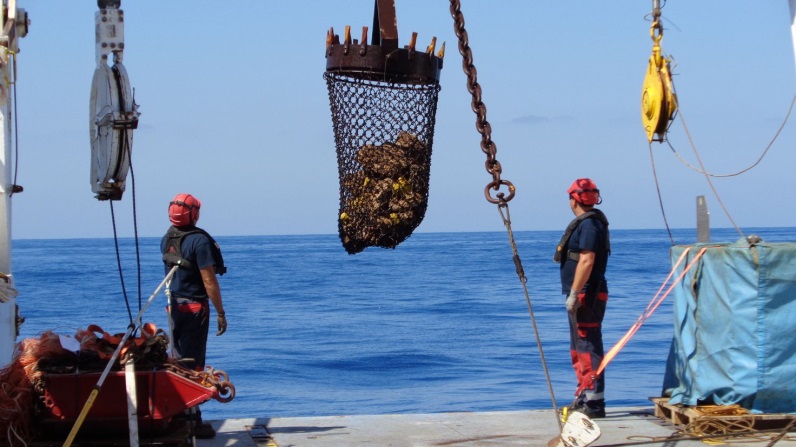
- Rock dredge samples (6; Figure 2) were obtained from morphological highs and consisted on breccia, sandstone with laminations, marl clast, conglomerate and a variety of coral fragments.
- Kullenberg piscon corers (26) were obtained with a maximum length of 567 cm. Preliminary observation indicates a high amount of sand and coarser material. Samples have still to be processed.
- Box corer samples (12) were obtained. These undisturbed sediment samples will be analysed to get a high-resolution study of the sub-seafloor.
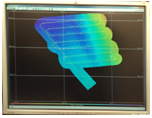
3) A mosaic of high-resolution (grid of 15 m; (Fig. 3) was obtained in the dune fields of the proximal Cadiz Contourite Channel. Two multibeam echosounders (SIMRAD EM710 and EM122) were used simultaneously. The data were processed on board.
4) The SIMRAD EK60 Single Beam echo sounder was used during the duration of the cruise to record profiles of the water column and seafloor, with the aim of characterizing water masses and the interfaces between them.
5) The two acoustic Doppler current profilers (ADCP) installed on the hull of the R/V L’Atalante where used during the GRACO cruise. The obtained dataset allows interpreting the character and behavior of the main water masses in the study area, but velocity data require further processing from raw data to incorporate heading, pitch and roll from vessel navigation system
|
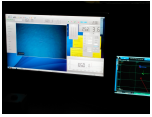
Figure 1. Workstation for Scampi acquisition, allowing a real-time observation of the seafloor
|