|
The EUROFLEETS Project is divided in three Activities (NA, TNA and JRA) and, its organizational structure will have to allow a rapid, coherent and well-accepted decision-making process. Here you can find what the management structure of the Project is.
In that purpose, the management of the project will be ensured according to the structure schematised in the following figure, allowing two different decision levels:
-
A strategic level, represented by the General Assembly (GA) to develop plans, to give scientific & technical orientations, to allocate the EC funds to achieve the final objectives of the project and the Executive Committee (ExComm) for the review of project progress and resources and resolution of eventual conflicts of Activities (NA, TNA, JRA);
- An operational level, represented by the Project Management Team, the Activity Coordinators (AC) and Work Package (WP) Leaders, to implement the strategic decisions and scientific & technical activities necessary to reach the goals of the Project.
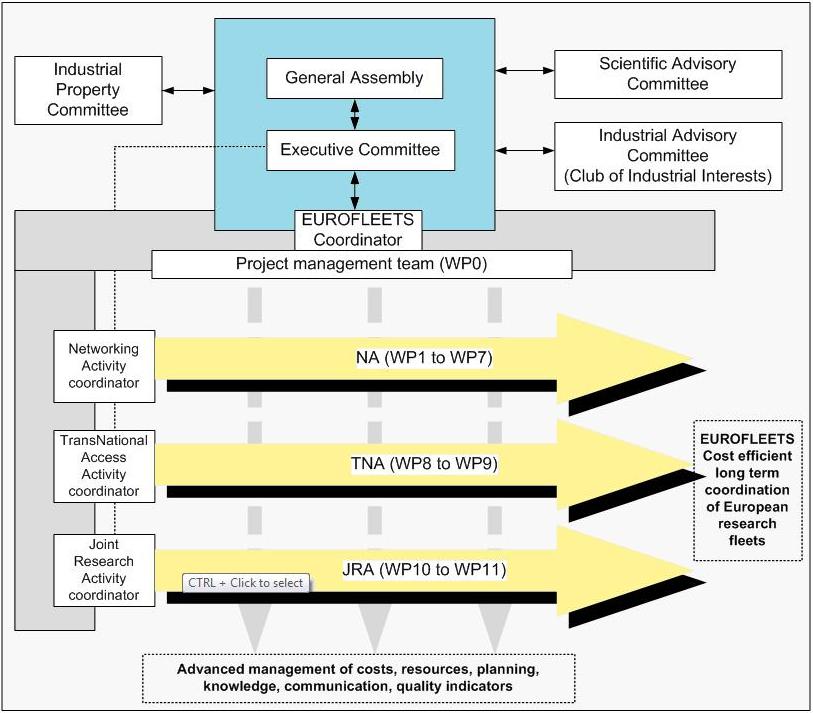
Based on the previous figure, the governance of the project is defined in detail in the Consortium Agreement. To enable efficiency and to avoid unnecessary complexity, the governance has been simplified as far as possible and comprises the following components:
- The Coordinator (Jacques BINOT, Ifremer) assuming the responsibility of the technical, financial and administrative management of the project according to the contractual guidelines. Within EUROFLEETS, he will be the chairman of the General Assembly and of the Executive Committee, and the sole interface between the European Commission and the Consortium.
- The General Assembly (GA), responsible for strategic policy and decision making. It is composed of high level representatives of all beneficiaries of the EUROFLEETS project. The GA meets at least once a year.
- The Executive Committee (ExComm) making decision concerning every aspect of the project life (technical, financial, schedule, partnership, dissemination and exploitation). It will also have to decide about the review of the project, the resources status and the allocation of funds (received and distributed by the Coordinator). It is composed of the Activity Coordinators (NA, TNA, JRA), the WP leaders on request, the Coordinator and, as advisors, the head of the management team and representatives of the two Advisory Committees (SAC and IAC). The ExComm will meet al least twice a year.
- Three Advisory Committees: the Scientific Advisory Committee (SAC), the Industrial Property Committee (IPC) and the Industrial Advisory Committee (IAC).
- The Project Management Team assisting the Coordinator in the management of administrative, contractual and financial aspects, organisation of inter- and intra- consortium communication, internal website, reporting, consortium agreement management. It is under the responsibility of the Coordinator and is in constant communication with the Executive Committee and with the AC and WP leaders.
-
The Activity Coordinators (AC), responsible for the animation of each Activity (NA, TNA, JRA).They will coordinate their Activity, continuously monitor the progress of quality indicators, report task activity to the whole consortium via Newsletters edited in the website, submit progress reports, ensure that milestones and deliverables of the tasks are fulfilled and organize focused meetings in order to determine suitable measures to be taken. The AC will meet bi-monthly on a periodic basis.
-
The Work Package (WP) Leaders, to control the progress of the scheduled work within the WP (in terms of technical achievement, planned deliverables, expense, to assess the quality of the outputs from their WP, to initiate and participate actively to the technical meetings necessary for work progress and report minutes, and to refer to their Activity Coordinators in case of major issues that affects the completion of the work foreseen.
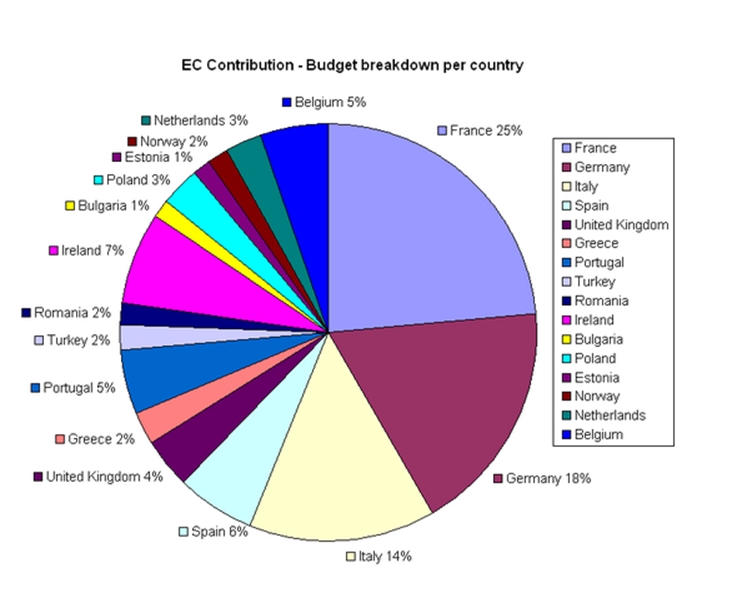
According to the objectives foreseen, the total cost of the EUROFLEETS project is estimated to about 8 953 737 Euros, with a maximum contribution from the European Commission equal to 7 200 000 Euros. This contribution is distributed according to the following percentages amongst the 16 countries involved in this project.
|